Markets
UK-India deal will be ‘a springboard for prosperity’

Updated 24 July
Sir Keir Starmer and his Indian counterpart Narendra Modi have formally signed a trade deal to lower tariffs on British exports, a move that will boost Scottish goods such as whisky and salmon.
Mr Modi was in the UK to formalise the Free Trade Agreement, first announced in May and seen as a springboard for British firms to grow their sales to the country by 60% by 2040.
The agreement means tariffs on more than 90% of UK exports to India will be cut, with the largest reductions on cosmetics, clothes and food and drink.
It represents a strengthening of relations between India, the world’s fifth largest economy, and th UK which is sixth.
India will benefit from the elimination of tariffs on about half of its exports to the UK, including textiles, footwear and agricultural produce such as mangoes and grapes, but the pact goes well beyond tariffs.
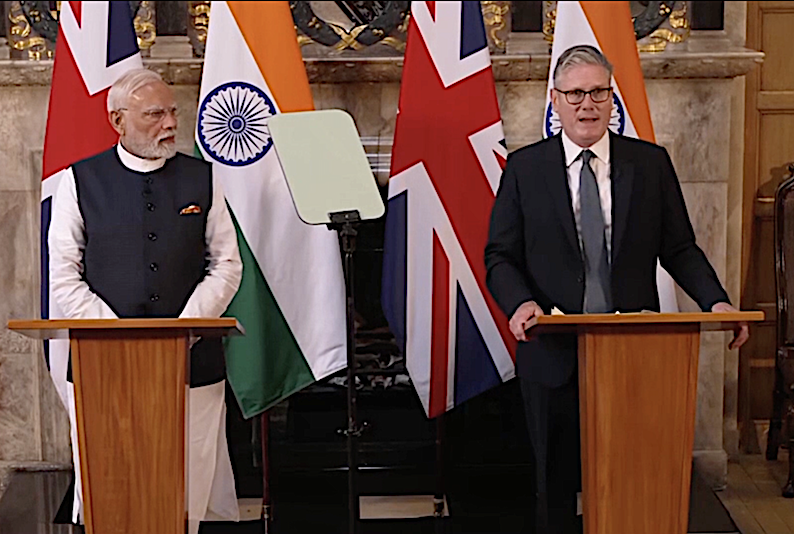
The UK did not accept India’s demands for broader visa access or post-study work rights, but it has allowed for greater movement, including the ability of Indian employers and employees on short-term transfers to avoid paying National Insurance contributions in the UK, a concession that has been controversial.
Naomi Smith, chief executive of Best for Britain, which campaigns for closer UK-EU ties, said: “Boris Johnson repeatedly promised he’d get this deal over the line by Diwali and so for Starmer to sew it up after one year in office is a significant achievement that both industry leaders and British workers are right to welcome.”
However, she said that the opportunities it offers, while significant, “are dwarfed by the continued cost of trade barriers with our largest market [the EU], highlighting the urgency of making progress on the areas agreed in May’s UK-EU summit, which voters have made clear is their priority.”
Rain Newton-Smith, chief executive of the CBI said: “In an era of rising protectionism, today’s announcement sends a powerful signal that the UK is open for business and remains resolute in its commitment to free and fair trade.
“A trade agreement with India – one of the world’s fastest-growing economies – is a springboard for long-term partnership and prosperity. UK firms can take advantage of this new platform to scale, diversify and compete on the global stage.
“The CBI looks forward to working closely alongside the Confederation of Indian Industry to turn ambition into action and negotiation into real-world impact. Ensuring this agreement delivers tangible benefits for businesses on both sides will be critical to meeting the UK’s growth ambitions.”
Scottish-Indian entrepreneur Nishant Sharma said his business stands to benefit directly.
Mr Sharma is the founder of Rutland Square Spirits, a craft gin brand based in Edinburgh and recently valued at £30 million. The company has secured backing from Bollywood star and entrepreneur Vivek Oberoi, and is scaling rapidly – with its signature gin now available in 14 airports across India.

The deal’s reduction in tariffs on UK gin and Scotch whisky marks a game-changing moment for the Scottish drinks industry, he said.
“Lower tariffs on Scotch and gin will open India, one of the world’s fastest-growing economies, to Scottish producers in a way we’ve never seen before.
“As someone born in India and now calling Edinburgh home, this moment feels deeply personal. It’s a bridge between two countries I care about, and a chance for the UK and Scotland to showcase its craftsmanship on a bigger stage. Exciting times lie ahead for our industry.”
US-Japan deal lifts market
News of a trade agreement between the US and Japan is fostering optimism among investors that further deals might be reached before punishing tariffs come into force, according to AJ Bell investment director Russ Mould.
The deal with Japan will include a 15% tariff on its exports. Mr Trump had previously threatened Japan, a major US trading partner, with a tariff of 25% beginning on August 1 if a deal was not reached.
It will open the Japanese market to American agricultural products and automobiles, key sectors for the US economy.
“We just completed a massive deal with Japan, perhaps the largest deal ever made,” Mr Trump announced on social media. “Japan will invest, at my direction, $550 billion into the US, which will receive 90% of the profits.”
The news helped drive the FTSE 100 to a new record high of 9080.09 before closing 37.68 points higher at 9,061.49.
There were also gains in other markets across mainland Europe – with the focus likely to turn to the prospects of an agreement being forged between the Trump administration and the EU.
Deutsche Bank’s Jim Reid said the Japan deal has “significantly raised hopes that the EU might also be able to reach a trade deal, as they’ve been threatened with 30% tariffs on August 1”.
In London, luxury car maker Aston Martin Lagonda rose 8.1% while other companies with tariff exposure were among the gainers, including GSK, AstraZeneca and Diageo.
The S&P 500 index has reached new all-time highs, climbing to the 6,350-point level.
Recent Posts
Trump unveils diesel supply agreement with Putin
Donald Trump cranked up the tension in the Ukraine war by reaching agreement with Russian PresidentRead More